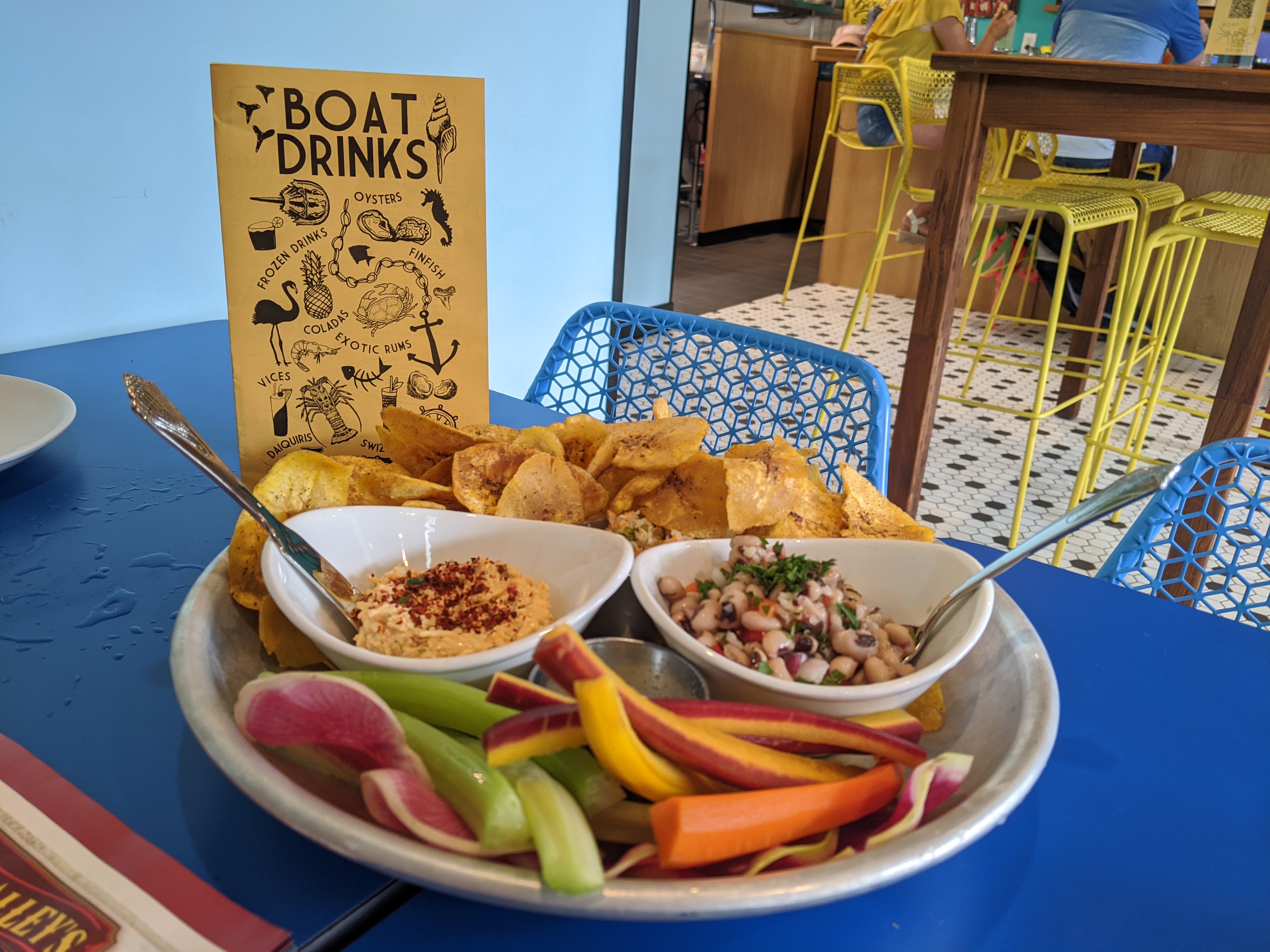
Boat Drinks – St. Augustine

During last Saturday’s torrential storm in St. Augustine, we ducked into a funky, Florida Keys-type eatery in the heart of St. George Street called Boat Drinks, which lives up to its billing as “a nautical tropical bar with frozen cocktails, a rum selection that would sink most ships and a bounty of fresh seafood.” Since it was early and we weren’t prepared for a full-blown meal, we opted to sample a couple of appetizers, including the Crispy Fish Bites (very good) and Plantain Chips ‘n Dips (outstanding). As you might expect, Boat Drinks specializes in an amazing selection of frozen drinks and rum punches, as well as rotating Florida craft beers. We had a great time at Boat Drinks and will definitely return soon! Oh yeah, we also hit one of our all-time favorite St. Augustine spots, Milltop Tavern. All in all, a very rewarding barhop in the “Ancient City” despite the awful weather.


Tragedy in U.S. History Museum Revisited

tragedy

Here are the contents of a couple of classic signs used to promote the long-defunct Tragedy in U.S. History Museum in St. Augustine:

“SEE Jayne Mansfield’s DEATH CAR … and learn the truth!”

“Inside You Will See: President Kennedy’s Car * Lee Harvey Oswald’s Car * The Ambulance He Died In * His Dallas Furniture and More * The Famous Zapruder Film * Bonnie and Clyde Getaway Car * Jayne Mansfield’s Car * Whistle from ‘Wreck of Old 97’ * Old Spanish Jail Built in 1718 Human Skeletons Inside * Antique Torture Equipment * Bear Traps * Flagler Tragedy * Elvis Presley’s Last Will and Much – Much More”

“Inside Tragedy Museum You Will See!
* President Kennedy’s Car
This is His Washington Limousine
* Jayne Mansfield Death Car
Famous Movie Star & the Truth of How She Died
* Also You Will See the Car Lee Harvey Used to Transport the Weapon that Killed the President
* See His Furniture from His Dallas Apartment
* See the Ambulance that Carried Him to His Death”

The Vedder Museum, St. Augustine

veddermuseum

The brainchild of “Dr.” John Vedder (1819-1899), the Vedder Museum, which opened in the 1880s at the corner of Treasury and Bay streets in St. Augustine, may very well have been Florida’s first “tourist trap.” In addition to an impressive collection of snakes and alligators, The Vedder Museum drew in customers with an assortment of “natural oddities and curiosities.” Following Vedder’s death in 1899, the St. Augustine Historical Society, purchased his entire collection (however, the Vedder Museum building itself burned to the ground in 1914). By the way, seven-foot-wide Treasury Street itself was billed as “The Narrowest Street in the United States.”

Old Fort Park


Listed on the National Register of Historic Places, the mysterious “Turnbull Ruins” are located within Old Fort Park off Riverside Drive in New Smyrna Beach. Constructed of coquina, the foundation features walls five-and-a-half feet thick. Some historians believe that the ruins may have once served as the foundation a Spanish fort that predates the Castillo de San Marcos in St. Augustine, while others claim they are simply the ruins of a mansion belonging to Scottish physician Andrew Turnbull (1718-92), who established the colony of New Smyrna in 1768.

A historical marker at the site reads: “This coquina foundation rests within a shell midden from the Timucuan Indian era. Mystery still surrounds the origin of this foundation. Jane and John Sheldon built a large hotel on this mound circa 1859. During the Civil War, the structure was destroyed by cannon fire from Union ships. After the Civil War, Jane Sheldon built a smaller structure that served as a pioneer general store, port collector’s office, boarding house and print shop, which published The Florida Star, one of the region’s early newspapers. Structural problems forced the building’s removal circa 1900.”

Old Fort Park also serves as the home of the historic New Smyrna Beach Free Library, which today houses the New Smyrna Beach Community Redevelopment Agency. In addition, the New Smyrna Museum of History can be found at 120 Sams Avenue, just one block from Old Fort Park (115 Julia Street).

Tragedy in U.S. History Museum

tragedyinushistorymuseum

Tragedy in U.S. History Museum, St. Augustine. “See Jayne Mansfield’s death car – learn the truth!” Some considered it in bad taste but the Tragedy in U.S. History Museum once served as a Mecca for roadside attraction aficionados. Opened in 1965 as the brainchild of L. H. “Buddy” Hough, the museum (basically a cluttered residential house located across the street from the “Authentic Old Jail”) featured such artifacts as Lee Harvey Oswald’s bedroom furniture, a wax figure of Oswald peering out of a window labeled “Texas School Book Depository,” a train whistle from “the wreck of the old 97,” antique torture equipment, a copy of Elvis’ last will and testament, the ambulance that carted Oswald away, a leather jacket once worn by James Dean, a frame-by-frame display of the Zapruder film and a limousine that John F. Kennedy once rode in (not the infamous Dallas limousine). In addition, the museum boasted the “death cars” of Bonnie and Clyde (actually the car used as a prop in the 1967 Bonnie and Clyde movie) and Jayne Mansfield (although it was the wrong make of car). Hough, who once claimed that on a good day that museum would get 10 visitors, battled with the City of St. Augustine for years in his efforts to open (he had to take his fight to the Florida Supreme Court), maintain and publicize his attraction (callers to the St. Augustine Chamber of Commerce were told that the museum had closed and they were snubbed by all of the official travel guides). According to Hough, in a 1989 interview with the Florida Times-Union, “Every human being has a morbid curiosity.” In another interview, Hough stated, “Tragedy is what made us great as Americans. Tragedy is what sticks with people. And the things that go with tragedies are very valuable. People want to see them and remember them. I don’t care what others say.” Hough passed away in 1996, the museum closed in 1998 and all the artifacts were auctioned off. As a side note, I was fortunate enough to visit the Tragedy in U.S. History Museum in the early 1990s and it was an unforgettable experience!