Boardwalk and Baseball

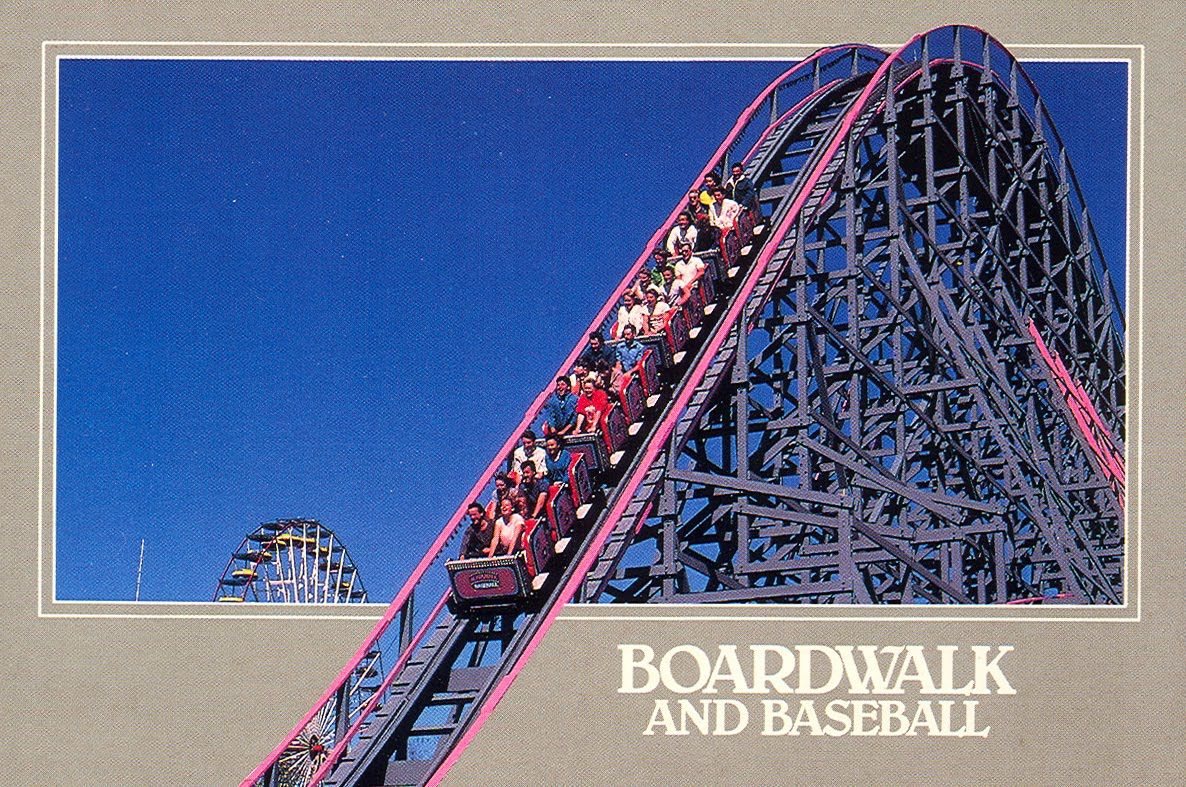
Built by Harcourt Brace Jovanovich (HBJ) on the site of what was formerly Circus World at the corner of Interstate 4 and U.S. 27 in Haines City, Boardwalk and Baseball opened on Valentine’s Day 1987 as a Florida theme park that rather unsuccessfully attempted to combine the vibe of an early 19th-century seaside boardwalk such as Atlantic City or Coney Island with an adjacent baseball stadium (“Baseball City Stadium”) that served as the Spring Training home of the Kansas City Royals until 2002. Notable attractions at 135-acre Boardwalk and Baseball included the Florida Hurricane roller coaster, Grand Rapids Flume Ride, Royal Lippizaner Horse Show, Great Moments in Baseball film and IMAX theater. In addition, ESPN taped a game show here called Boardwalk and Baseball’s Super Bowl of Sports Trivia featuring Chris Berman as host. According to a March 5, 1988, New York Times article (“Baseball by the Boardwalk”), “Neither the stadium nor the amusement park was overflowing with people today. The 7,000-seat stadium, one of the finest in Florida, had only 3,281 fans, and many drifted back and forth between the game and the rides … The Boardwalk label for the amusement park is somewhat mystifying because boardwalks are usually associated with water, and the only water in the park fills various lakes and the log flume ride.” In 1989, HBJ sold Boardwalk and Baseball to Busch Entertainment Corporation, but dismal crowds led to the closing of the theme park on January 17, 1990. According to an article in the Tampa Bay Times announcing the closure, “Boardwalk and Baseball, a switch-hitting Central Florida amusement park that tried to combine home runs and roller coasters, has struck out. Anheuser-Busch Cos. Inc., which has owned the park since November, closed it without warning Wednesday afternoon. The corporation said the amusement … was losing money faster and faster with no prospects for improvement.” The former Boardwalk and Baseball site is now occupied by the immense Posner Park shopping complex.


JungleLand Zoo, Kissimmee

junglelandzoo.jpg

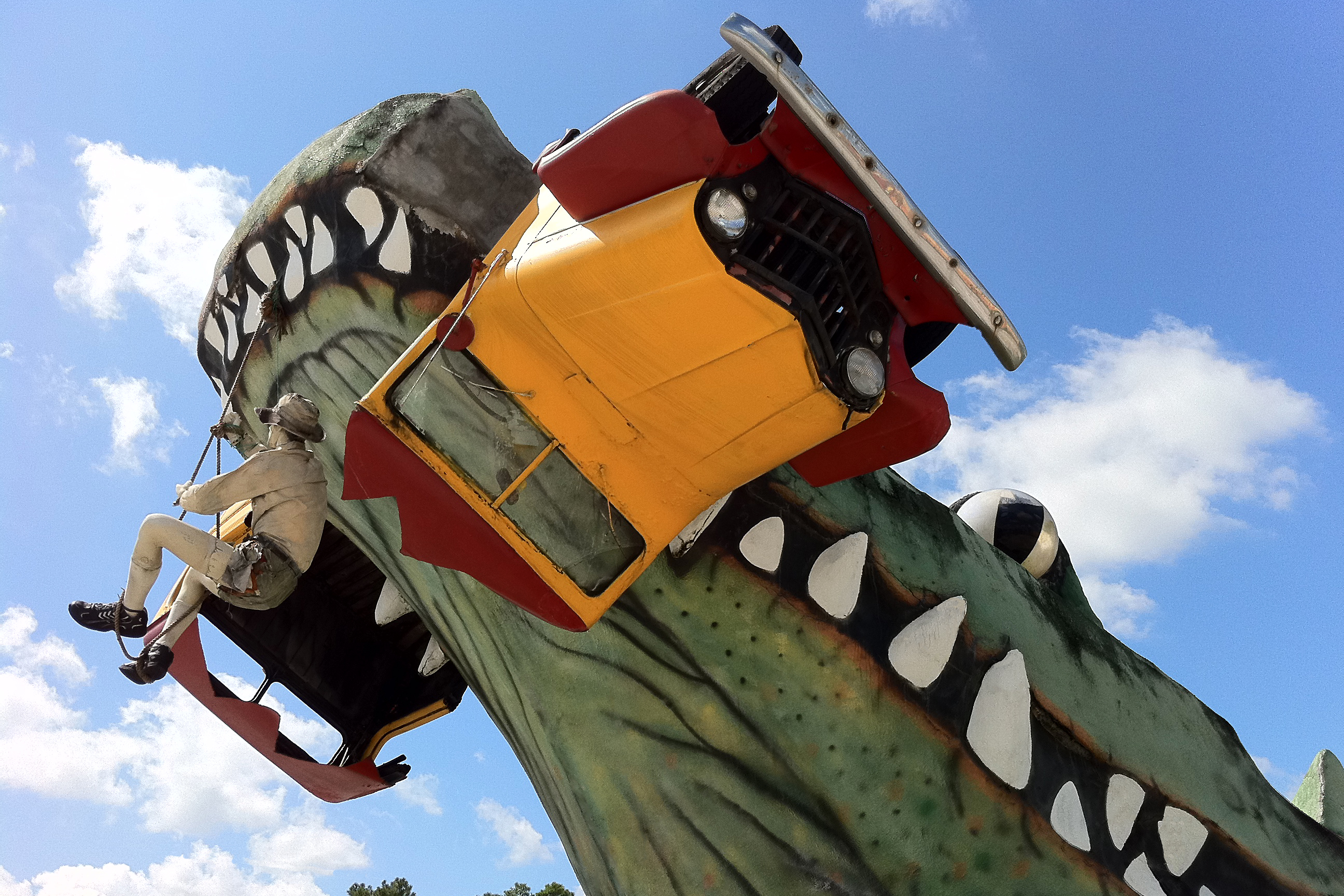
Best known for a huge concrete alligator (with a safari jeep clenched in its jaws and guide hanging on a rope for dear life!) at its entrance and the highly publicized escape of a 450-pound lion named “Nala” during the late 1990s, JungleLand Zoo first opened along U.S. 192 in Kissimmee in 1995 (an earlier attraction named Alligatorland Safari Zoo previously occupied the site) and featured more than 300 “exotic animals” on display (including African leopards, Bengal tigers, African caracal, a Siberian tiger and orangutan named “Radcliffe”), as well as a big cat show, “Bushmasters” Gator Show, “Magic of the Rainforest” magic show and other attractions. Nala’s brief adventure was documented in an article, “10 Weirdest Zoo Animal Escapes,” by CNN: “The declawed lion prowled the area, much to the chagrin of residents. Thankfully, no one was hurt. After a few days on the loose, Nala was found by a search team and returned to her pen.” JungleLand Zoo was also the home of “Stinker the Monkey.” Animal rights activists brought the heat on JungleLand Zoo for the alleged mistreatment of animals, but the owners and employees vehemently denied the claims. The Zoo was also reportedly cited by the Florida Fish and Wildlife Conservation Commission for several violations. Regardless, JungleLand Zoo, facing a steep drop in attendance due to the 9/11 terrorist attacks, closed its doors for good in 2002.

Ocean World

Opened in 1965, Ocean World was located on the 17th Street Causeway adjacent to Pier 66 in Fort Lauderdale and featured Davy Jones’ Locker, home to “The Flying Dolphin Show,” as well as a dolphin feeding pool, California sea lions, otters, sea turtles, fish, alligators and tropical birds. However, the small marine mammal park became the target of animal rights activists in the 1980s, which led to legal action from the U.S. Department of Agriculture (resulting in a $20,000 fine) and Ocean World ultimately was closed its doors in 1994. The park’s dolphins were reportedly relocated to a marine park in Honduras. A July 5, 1994, Sun-Sentinel article reported: “Ocean World, one of the city’s oldest and most controversial tourist attractions, will put on its last dolphin and sea lion show Aug. 31. Ocean World President George Boucher cited declining attendance and limited space for expansion as the reasons the 29-year-old marine theme park is closing.”

Ocala Caverns

Also once known as “Uranium Valley and Caves,” the Ocala Caverns were located on U.S. routes 301, 27 and 441, approximately eight miles South of Ocala. According to legend, the caverns were used as a hiding place by runaway slaves during the Civil War. The Ocala Caverns were open to the public as an attraction in the 1950s and 1960s, and at one time owned by a pro wrestler known as “Man Mountain Dean Jr.” and “Mighty Jumbo” (real name: Samuel Hesser), who weighed in at nearly 650 lbs., and Violet Ray, “Women’s Lightweight Wrestling Champion.” Attractions included two caves (one dry, one wet), an underground boat ride (basically Hesser kicked the rowboat out so tourists could get a glimpse of the cave and then he pulled it back with a rope), Callaway’s Rock Display, Inca Indian Museum, Wrestling Hall of Fame and Santa Claus Land (Hesser even made the December 1966 cover of the Ocala-Marion County Visitors Guide to the Kingdom of the Sun dressed as Santa Claus). The attraction closed in the late 1960s or early 1970s, and Hesser reportedly passed away from a brain tumor at the age of 51 in Iowa in 1974. In recent years, the Florida Speleological Society has made efforts to clean up the Ocala Caverns site.

Tragedy in U.S. History Museum

tragedyinushistorymuseum

Tragedy in U.S. History Museum, St. Augustine. “See Jayne Mansfield’s death car – learn the truth!” Some considered it in bad taste but the Tragedy in U.S. History Museum once served as a Mecca for roadside attraction aficionados. Opened in 1965 as the brainchild of L. H. “Buddy” Hough, the museum (basically a cluttered residential house located across the street from the “Authentic Old Jail”) featured such artifacts as Lee Harvey Oswald’s bedroom furniture, a wax figure of Oswald peering out of a window labeled “Texas School Book Depository,” a train whistle from “the wreck of the old 97,” antique torture equipment, a copy of Elvis’ last will and testament, the ambulance that carted Oswald away, a leather jacket once worn by James Dean, a frame-by-frame display of the Zapruder film and a limousine that John F. Kennedy once rode in (not the infamous Dallas limousine). In addition, the museum boasted the “death cars” of Bonnie and Clyde (actually the car used as a prop in the 1967 Bonnie and Clyde movie) and Jayne Mansfield (although it was the wrong make of car). Hough, who once claimed that on a good day that museum would get 10 visitors, battled with the City of St. Augustine for years in his efforts to open (he had to take his fight to the Florida Supreme Court), maintain and publicize his attraction (callers to the St. Augustine Chamber of Commerce were told that the museum had closed and they were snubbed by all of the official travel guides). According to Hough, in a 1989 interview with the Florida Times-Union, “Every human being has a morbid curiosity.” In another interview, Hough stated, “Tragedy is what made us great as Americans. Tragedy is what sticks with people. And the things that go with tragedies are very valuable. People want to see them and remember them. I don’t care what others say.” Hough passed away in 1996, the museum closed in 1998 and all the artifacts were auctioned off. As a side note, I was fortunate enough to visit the Tragedy in U.S. History Museum in the early 1990s and it was an unforgettable experience!

Cypress Knee Museum

cypresskneemuseum

Cypress Knee Museum, Palmdale. Visionary Tom Gaskins first became fascinated with cypress knees in the 1930s and his obsession evolved into a famous roadside attraction along U.S. 27 in Palmdale that boasted a museum, cypress knee factory, gift shop and crudely designed catwalk through a cypress swamp. Signs along the highway would beckon tourists to stop at the museum with messages such as “Lady, If He Won’t Stop, Hit Him On Head With Shoe.” A barefoot Gaskins donning his favorite cypress hat would often greet visitors and give them a highly entertaining tour of the facilities, along with some of his favorite cypress knees such as the one that resembled a “Lady Hippo Wearing a Carmen Miranda Hat.” Gaskins even self published a book in 1978 called Florida Facts and Fallacies. The “About the Author” section of the book states that Gaskins “worked with and was salesman for Gator Roach killer until 1934 when he married Virginia Bible and started the cypress knee industry . . . The Cypress Knee Museum was opened in 1951 . . . [Gaskins] is a woodsman, hunter, fisherman, woodcarver, physical culturist (jogged eleven miles on his 69th birthday), member of John Birch Society, said-to-be wit and philosopher, and wood-be perfectionist. He holds ten U.S. patents.” Unfortunately, with the arrival of the Florida Turnpike, I-95 and I-75, tourist traffic along U.S. 27 dried up and the Cypress Knee Museum hit hard times. Gaskins passed away in 1998 and his son, Tom Jr., tried valiantly to keep the museum open but was forced to close up shop in 2000 after a break-in.

Xanadu: Home of the Future

xanaduhomeofthefuture

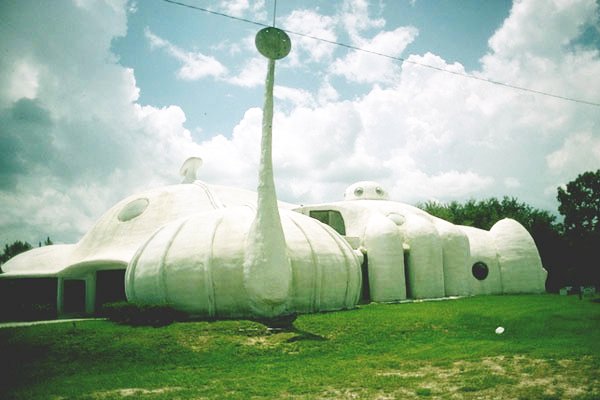
Xanadu: Home of the Future, Kissimmee. Built in 1983, the odd, bubble-shaped Xanadu: Home of the Future attraction off U.S. 192 was actually one of three Xanadu homes of the future (the other two were located in Gatlinburg, Tennessee, and Wisconsin Dells, Wisconsin). The name “Xanadu” was chosen as a homage to Kublai Khan’s summer capital, which inspired Samuel Taylor Coleridge’s famous poem, “Kubla Khan.” All three energy-efficient, dome-shaped homes were built of polyurethane foam and known for their curved walls and cramped rooms. However, the technology within the Xanadu homes became laughably dated quickly. Xanadu closed its doors in 1996 and became a haven for vandals and homeless squatters before being finally demolished in 2005. The abandoned Xanadu house was featured in the 2007 documentary, Urban Explorers: Into the Darkness.