The Yearling Restaurant

yearlingrestaurant

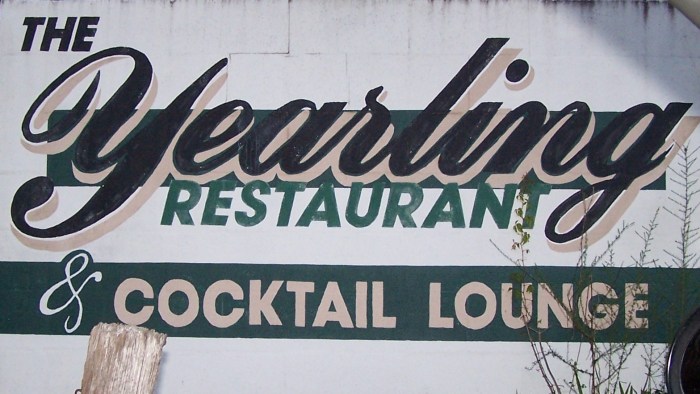
Step back in time to “Old Florida” at The Yearling Restaurant, a local landmark in the Cross Creek area (way off the beaten path!) that first opened its doors in 1952 and specializes in Southern “cracker-style” cuisine. Enjoy live music courtesy of legendary bluesman Willie “The Real Deal” Green. Named after Marjorie Kinnan Rawling’s Pulitzer-Prize-winning 1938 novel, The Yearling, the award-winning Yearling Restaurant lies less than a mile from the Marjorie Kinnan Rawlings Historic State Park (I personally advise visiting this must-see attraction in the morning followed by lunch at The Yearling). Or choose to spend the night at the adjacent Secret River Lodge, which boasts seven restored cottages. The eclectic menu at The Yearling features such offbeat delicacies as Florida Gator, Frog Legs, Free Range Venison, Fried Portobello Mushrooms, Conch Fritters, Stuffed Grouper, Blackened Mississippi Catfish, Maple Leaf Duck Breast and Domestic Quail, as well as steaks, burgers, sandwiches and more. Save room for one of the signature desserts such as Key Lime Pie, Pecan Pie, Sour Orange Pie and Buttermilk Pie. The Yearling Restaurant is located at 14531 County Road 325 in Hawthorne, just 14 miles from Gainesville. Don’t be scared off by the eatery’s rather rough exterior – it’s all part of the charm! It is open for lunch and dinner Thursday through Sunday. For more information, visit www.yearlingrestaurant.net.
Fort Jefferson

drytortugas

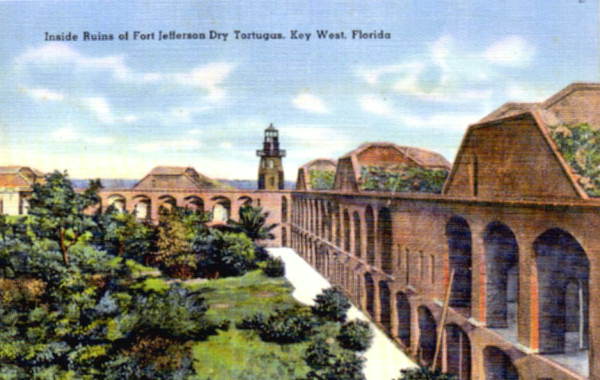
The largest all-masonry fort in the United States, Fort Jefferson (named after Thomas Jefferson) was constructed with more than 16 million bricks between 1846 and 1875 on Garden Key, which lies approximately 70 miles West of Key West. A federal outpost during the Civil War, Fort Jefferson held more than 500 prisoners by 1865 and in July of that year added Dr. Samuel Mudd, Edmund Spangler, Samuel Arnold and Michael O’Laughlen – all of whom had been convicted in the assassination of President Abraham Lincoln. Mudd was eventually pardoned by President Andrew Johnson after treating the victims of a yellow fever epidemic at Fort Jefferson in 1867. The Prisoner of Shark Island (1936), which starred Warner Baxter and Gloria Stuart, was loosely based on the life of Mudd. In 1935, President Franklin D. Roosevelt designated the area as Fort Jefferson National Monument and the fort was listed on the National Register of Historic Places in 1970. Fort Jefferson lies within the 64,701-acre Dry Tortugas National Park, which is accessible only by boat or seaplane.

Ocala Caverns

Also once known as “Uranium Valley and Caves,” the Ocala Caverns were located on U.S. routes 301, 27 and 441, approximately eight miles South of Ocala. According to legend, the caverns were used as a hiding place by runaway slaves during the Civil War. The Ocala Caverns were open to the public as an attraction in the 1950s and 1960s, and at one time owned by a pro wrestler known as “Man Mountain Dean Jr.” and “Mighty Jumbo” (real name: Samuel Hesser), who weighed in at nearly 650 lbs., and Violet Ray, “Women’s Lightweight Wrestling Champion.” Attractions included two caves (one dry, one wet), an underground boat ride (basically Hesser kicked the rowboat out so tourists could get a glimpse of the cave and then he pulled it back with a rope), Callaway’s Rock Display, Inca Indian Museum, Wrestling Hall of Fame and Santa Claus Land (Hesser even made the December 1966 cover of the Ocala-Marion County Visitors Guide to the Kingdom of the Sun dressed as Santa Claus). The attraction closed in the late 1960s or early 1970s, and Hesser reportedly passed away from a brain tumor at the age of 51 in Iowa in 1974. In recent years, the Florida Speleological Society has made efforts to clean up the Ocala Caverns site.

Caribbean Club, Key Largo

caribbeanclub

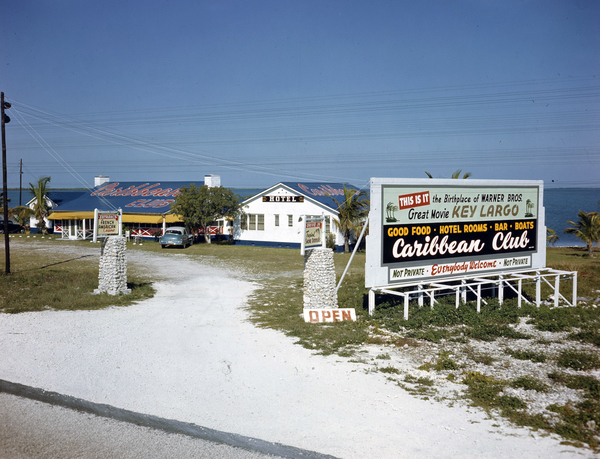
According to its official website, the Caribbean Club was opened in 1938 by legendary automotive and real estate promoter Carl Fisher “as a poor-man’s fishing retreat.” It later became a gambling den. The bar served as a filming location for exterior shots from the classic 1948 film Key Largo, which was directed by John Huston and starred Humphrey Bogart, Lauren Bacall and Edward G. Robinson. The photo above was taken by legendary commercial photographer Joseph Janney Steinmetz (1905-1985). The Caribbean Club is the oldest bar in the Upper Keys. Today, the bar offers “live music, daily happy hours, waterfront sunset views and a dog-friendly atmosphere.” Ideally located at Mile Marker 104 bayside, it is open 7 AM to 4 AM “every damn day.” Note: The Caribbean Club is a cash-only bar with an onsite ATM. The bar served as a filming location for the Netflix original series, Bloodline. According to Jimmy Buffett, “It was a bar like many others and then it wasn’t.”


Kayaking to Indian Key

We always make at least one stop at bustling Robbie’s Marina in Islamorada (Mile Marker 77) on the way to or from Key West. We usually grab a bite to eat at the Hungry Tarpon Restaurant, feed the giant tarpon from the dock and wander around the quaint, open-air shops. However, last year we decided to rent kayaks from the Kayak Shack at Robbie’s Marina and take a kayaking adventure to Indian Key Historic State Park. After renting kayaks (we went solo, but the Kayak Shack also offers guided tours), we headed away from Robbie’s and under the Overseas Highway to open waters. Indian Key is only about a mile or so away, so it wasn’t too strenuous at all. Once we docked our kayaks, we wandered around the trails, checked out the historic ruins and climbed the wooden tower for a nice panoramic view of the surrounding area (we had the whole island to ourselves!). Indian Key has a fascinating and tragic history. In the 1830s, the island was the site of a burgeoning settlement established by a somewhat “ruthless” and “unscrupulous” wrecker named Captain John Jacob Housman (1799-1841). During the Second Seminole War in 1841, Housman and some other inhabitants of Indian Key were killed by Calusa Indians during a raid on the island (reportedly they had been tipped off about Housman’s offer to the federal government that he was willing to capture and/or kill all of the Indians in the area for $200 each). Housman’s grave is located on Indian Key and features the following inscription: “Here lieth the body of Capt. Jacob Housman, formerly of Staten Island, State of New York, Proprietor of this island, who died by accident May 1st, 1841, aged 41 years 11 months. To his friends he was sincere, to his enemies he was kind, to all men faithful. This monument is erected by his most disconsolate though affectionate wife, Elizabeth Ann Housman. Sic Transit Gloria Mundi.” Our kayaking trip to Indian Key turned out to be one of the most memorable outdoor excursions we have taken in the Florida Keys. Next time, we will set our sights on kayaking to nearby Lignumvitae Key Botanical State Park.

Tragedy in U.S. History Museum

tragedyinushistorymuseum

Tragedy in U.S. History Museum, St. Augustine. “See Jayne Mansfield’s death car – learn the truth!” Some considered it in bad taste but the Tragedy in U.S. History Museum once served as a Mecca for roadside attraction aficionados. Opened in 1965 as the brainchild of L. H. “Buddy” Hough, the museum (basically a cluttered residential house located across the street from the “Authentic Old Jail”) featured such artifacts as Lee Harvey Oswald’s bedroom furniture, a wax figure of Oswald peering out of a window labeled “Texas School Book Depository,” a train whistle from “the wreck of the old 97,” antique torture equipment, a copy of Elvis’ last will and testament, the ambulance that carted Oswald away, a leather jacket once worn by James Dean, a frame-by-frame display of the Zapruder film and a limousine that John F. Kennedy once rode in (not the infamous Dallas limousine). In addition, the museum boasted the “death cars” of Bonnie and Clyde (actually the car used as a prop in the 1967 Bonnie and Clyde movie) and Jayne Mansfield (although it was the wrong make of car). Hough, who once claimed that on a good day that museum would get 10 visitors, battled with the City of St. Augustine for years in his efforts to open (he had to take his fight to the Florida Supreme Court), maintain and publicize his attraction (callers to the St. Augustine Chamber of Commerce were told that the museum had closed and they were snubbed by all of the official travel guides). According to Hough, in a 1989 interview with the Florida Times-Union, “Every human being has a morbid curiosity.” In another interview, Hough stated, “Tragedy is what made us great as Americans. Tragedy is what sticks with people. And the things that go with tragedies are very valuable. People want to see them and remember them. I don’t care what others say.” Hough passed away in 1996, the museum closed in 1998 and all the artifacts were auctioned off. As a side note, I was fortunate enough to visit the Tragedy in U.S. History Museum in the early 1990s and it was an unforgettable experience!

Cypress Knee Museum

cypresskneemuseum

Cypress Knee Museum, Palmdale. Visionary Tom Gaskins first became fascinated with cypress knees in the 1930s and his obsession evolved into a famous roadside attraction along U.S. 27 in Palmdale that boasted a museum, cypress knee factory, gift shop and crudely designed catwalk through a cypress swamp. Signs along the highway would beckon tourists to stop at the museum with messages such as “Lady, If He Won’t Stop, Hit Him On Head With Shoe.” A barefoot Gaskins donning his favorite cypress hat would often greet visitors and give them a highly entertaining tour of the facilities, along with some of his favorite cypress knees such as the one that resembled a “Lady Hippo Wearing a Carmen Miranda Hat.” Gaskins even self published a book in 1978 called Florida Facts and Fallacies. The “About the Author” section of the book states that Gaskins “worked with and was salesman for Gator Roach killer until 1934 when he married Virginia Bible and started the cypress knee industry . . . The Cypress Knee Museum was opened in 1951 . . . [Gaskins] is a woodsman, hunter, fisherman, woodcarver, physical culturist (jogged eleven miles on his 69th birthday), member of John Birch Society, said-to-be wit and philosopher, and wood-be perfectionist. He holds ten U.S. patents.” Unfortunately, with the arrival of the Florida Turnpike, I-95 and I-75, tourist traffic along U.S. 27 dried up and the Cypress Knee Museum hit hard times. Gaskins passed away in 1998 and his son, Tom Jr., tried valiantly to keep the museum open but was forced to close up shop in 2000 after a break-in.

Xanadu: Home of the Future

xanaduhomeofthefuture

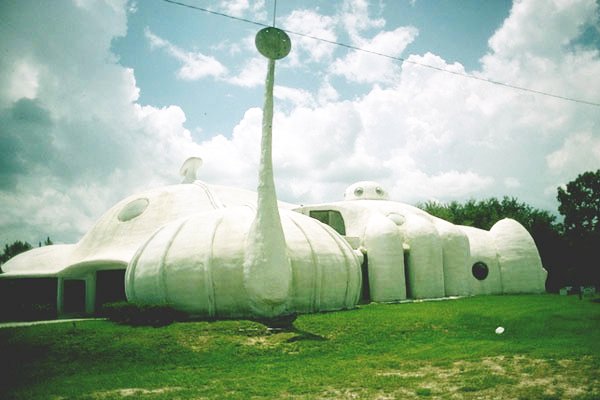
Xanadu: Home of the Future, Kissimmee. Built in 1983, the odd, bubble-shaped Xanadu: Home of the Future attraction off U.S. 192 was actually one of three Xanadu homes of the future (the other two were located in Gatlinburg, Tennessee, and Wisconsin Dells, Wisconsin). The name “Xanadu” was chosen as a homage to Kublai Khan’s summer capital, which inspired Samuel Taylor Coleridge’s famous poem, “Kubla Khan.” All three energy-efficient, dome-shaped homes were built of polyurethane foam and known for their curved walls and cramped rooms. However, the technology within the Xanadu homes became laughably dated quickly. Xanadu closed its doors in 1996 and became a haven for vandals and homeless squatters before being finally demolished in 2005. The abandoned Xanadu house was featured in the 2007 documentary, Urban Explorers: Into the Darkness.