King Henry’s Feast

kinghenry

King Henry’s Feast was a popular tourist attraction on International Drive in Orlando that operated from 1986 to 1999. According to a 1987 Orlando Sentinel article, “Down on tawdry International Drive, which enjoys a certain notoriety in these parts, the tourist-trade establishments blend together in one neon blur. But one of them stands apart, at least in terms of architectural novelty: King Henry’s Feast is a gargantuan fortressy affair with pink and white turrets. The self-proclaimed ‘Entertainment Banquet Attraction,’ which went by the name Shakespeare’s Tavern when it was housed in downtown Orlando, moved to International Drive in early 1986.”

JungleLand Zoo, Kissimmee

junglelandzoo.jpg

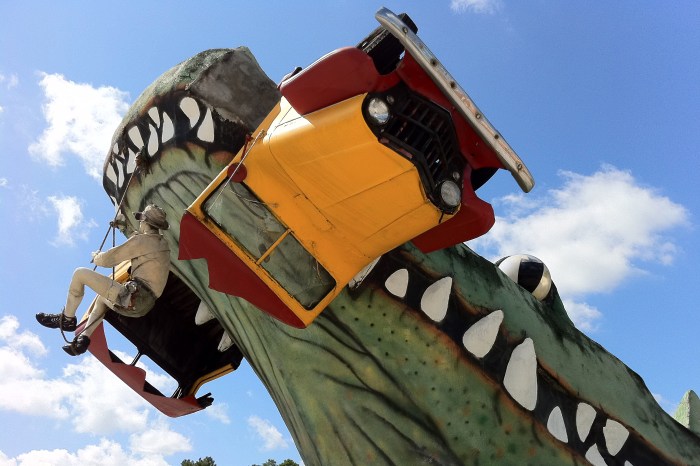
Best known for a huge concrete alligator (with a safari jeep clenched in its jaws and guide hanging on a rope for dear life!) at its entrance and the highly publicized escape of a 450-pound lion named “Nala” during the late 1990s, JungleLand Zoo first opened along U.S. 192 in Kissimmee in 1995 (an earlier attraction named Alligatorland Safari Zoo previously occupied the site) and featured more than 300 “exotic animals” on display (including African leopards, Bengal tigers, African caracal, a Siberian tiger and orangutan named “Radcliffe”), as well as a big cat show, “Bushmasters” Gator Show, “Magic of the Rainforest” magic show and other attractions. Nala’s brief adventure was documented in an article, “10 Weirdest Zoo Animal Escapes,” by CNN: “The declawed lion prowled the area, much to the chagrin of residents. Thankfully, no one was hurt. After a few days on the loose, Nala was found by a search team and returned to her pen.” JungleLand Zoo was also the home of “Stinker the Monkey.” Animal rights activists brought the heat on JungleLand Zoo for the alleged mistreatment of animals, but the owners and employees vehemently denied the claims. The Zoo was also reportedly cited by the Florida Fish and Wildlife Conservation Commission for several violations. Regardless, JungleLand Zoo, facing a steep drop in attendance due to the 9/11 terrorist attacks, closed its doors for good in 2002.

Tragedy in U.S. History Museum

tragedyinushistorymuseum

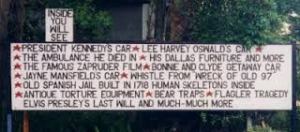
Tragedy in U.S. History Museum, St. Augustine. “See Jayne Mansfield’s death car – learn the truth!” Some considered it in bad taste but the Tragedy in U.S. History Museum once served as a Mecca for roadside attraction aficionados. Opened in 1965 as the brainchild of L. H. “Buddy” Hough, the museum (basically a cluttered residential house located across the street from the “Authentic Old Jail”) featured such artifacts as Lee Harvey Oswald’s bedroom furniture, a wax figure of Oswald peering out of a window labeled “Texas School Book Depository,” a train whistle from “the wreck of the old 97,” antique torture equipment, a copy of Elvis’ last will and testament, the ambulance that carted Oswald away, a leather jacket once worn by James Dean, a frame-by-frame display of the Zapruder film and a limousine that John F. Kennedy once rode in (not the infamous Dallas limousine). In addition, the museum boasted the “death cars” of Bonnie and Clyde (actually the car used as a prop in the 1967 Bonnie and Clyde movie) and Jayne Mansfield (although it was the wrong make of car). Hough, who once claimed that on a good day that museum would get 10 visitors, battled with the City of St. Augustine for years in his efforts to open (he had to take his fight to the Florida Supreme Court), maintain and publicize his attraction (callers to the St. Augustine Chamber of Commerce were told that the museum had closed and they were snubbed by all of the official travel guides). According to Hough, in a 1989 interview with the Florida Times-Union, “Every human being has a morbid curiosity.” In another interview, Hough stated, “Tragedy is what made us great as Americans. Tragedy is what sticks with people. And the things that go with tragedies are very valuable. People want to see them and remember them. I don’t care what others say.” Hough passed away in 1996, the museum closed in 1998 and all the artifacts were auctioned off. As a side note, I was fortunate enough to visit the Tragedy in U.S. History Museum in the early 1990s and it was an unforgettable experience!

Cypress Knee Museum

cypresskneemuseum

Cypress Knee Museum, Palmdale. Visionary Tom Gaskins first became fascinated with cypress knees in the 1930s and his obsession evolved into a famous roadside attraction along U.S. 27 in Palmdale that boasted a museum, cypress knee factory, gift shop and crudely designed catwalk through a cypress swamp. Signs along the highway would beckon tourists to stop at the museum with messages such as “Lady, If He Won’t Stop, Hit Him On Head With Shoe.” A barefoot Gaskins donning his favorite cypress hat would often greet visitors and give them a highly entertaining tour of the facilities, along with some of his favorite cypress knees such as the one that resembled a “Lady Hippo Wearing a Carmen Miranda Hat.” Gaskins even self published a book in 1978 called Florida Facts and Fallacies. The “About the Author” section of the book states that Gaskins “worked with and was salesman for Gator Roach killer until 1934 when he married Virginia Bible and started the cypress knee industry . . . The Cypress Knee Museum was opened in 1951 . . . [Gaskins] is a woodsman, hunter, fisherman, woodcarver, physical culturist (jogged eleven miles on his 69th birthday), member of John Birch Society, said-to-be wit and philosopher, and wood-be perfectionist. He holds ten U.S. patents.” Unfortunately, with the arrival of the Florida Turnpike, I-95 and I-75, tourist traffic along U.S. 27 dried up and the Cypress Knee Museum hit hard times. Gaskins passed away in 1998 and his son, Tom Jr., tried valiantly to keep the museum open but was forced to close up shop in 2000 after a break-in.

Xanadu: Home of the Future

xanaduhomeofthefuture

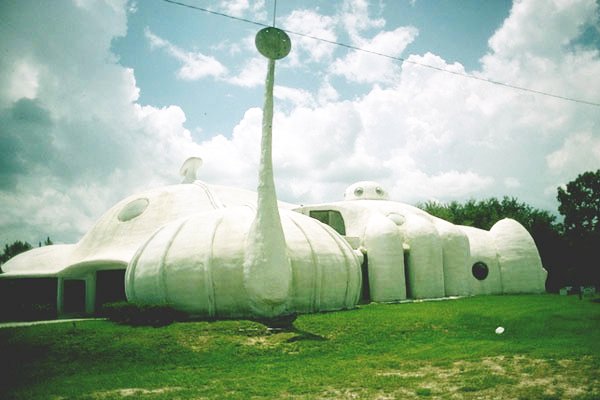
Xanadu: Home of the Future, Kissimmee. Built in 1983, the odd, bubble-shaped Xanadu: Home of the Future attraction off U.S. 192 was actually one of three Xanadu homes of the future (the other two were located in Gatlinburg, Tennessee, and Wisconsin Dells, Wisconsin). The name “Xanadu” was chosen as a homage to Kublai Khan’s summer capital, which inspired Samuel Taylor Coleridge’s famous poem, “Kubla Khan.” All three energy-efficient, dome-shaped homes were built of polyurethane foam and known for their curved walls and cramped rooms. However, the technology within the Xanadu homes became laughably dated quickly. Xanadu closed its doors in 1996 and became a haven for vandals and homeless squatters before being finally demolished in 2005. The abandoned Xanadu house was featured in the 2007 documentary, Urban Explorers: Into the Darkness.