


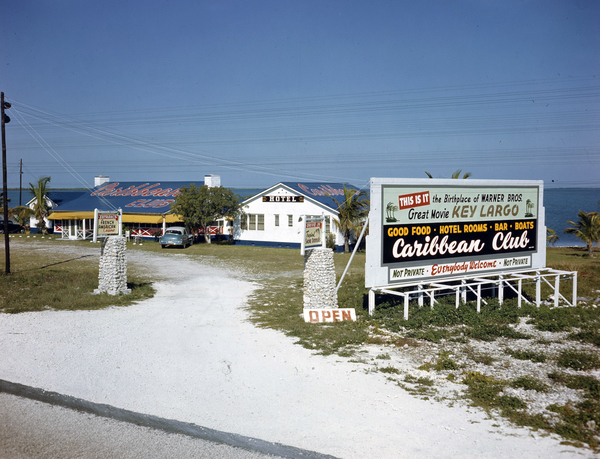
According to its official website, the Caribbean Club was opened in 1938 by legendary automotive and real estate promoter Carl Fisher “as a poor-man’s fishing retreat.” It later became a gambling den. The bar served as a filming location for exterior shots from the classic 1948 film Key Largo, which was directed by John Huston and starred Humphrey Bogart, Lauren Bacall and Edward G. Robinson. The photo above was taken by legendary commercial photographer Joseph Janney Steinmetz (1905-1985). The Caribbean Club is the oldest bar in the Upper Keys. Today, the bar offers “live music, daily happy hours, waterfront sunset views and a dog-friendly atmosphere.” Ideally located at Mile Marker 104 bayside, it is open 7 AM to 4 AM “every damn day.” Note: The Caribbean Club is a cash-only bar with an onsite ATM. The bar served as a filming location for the Netflix original series, Bloodline. According to Jimmy Buffett, “It was a bar like many others and then it wasn’t.”

“Because we don’t know when we will die, we get to think of life as an inexhaustible well. Yet everything happens only a certain number of times, and a very small number really. How many more times will you remember a certain afternoon of your childhood, some afternoon that is so deeply a part of your being that you can’t even conceive of your life without it? Perhaps four or five times more, perhaps not even that. How many more times will you watch the full moon rise? Perhaps twenty. And yet it all seems limitless.” – Paul Bowles, The Sheltering Sky (1949)
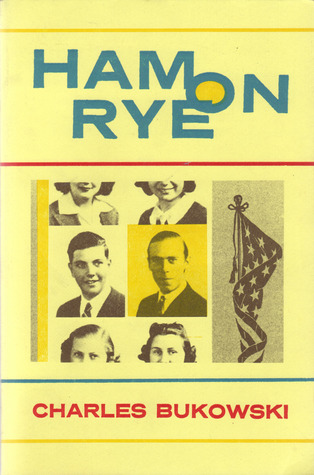
“I wasn’t a misanthrope and I wasn’t a misogynist but I liked being alone. It felt good to sit alone in a small space and smoke and drink. I had always been good company for myself.” According to Charles Bukowski’s fourth novel, Ham on Rye (1982), he had a miserable childhood courtesy of his father, a sadistic tyrant who regularly beat young Henry and his mother over the slightest infractions. To make matters worse, Bukowski suffered from a rare skin disorder, diagnosed as acne vulgaris, once he reached his teens. His only refuge was the local public library, where he voraciously devoured the writings of “The Lost Generation” school of American novelists such as Ernest Hemingway (whose later works he despised), Sherwood Anderson and John Dos Passos, as well as the works of European writers, including Fyodor Dostoyevsky’s Notes from the Underground, Knut Hamsun’s Hunger and Louis-Ferdinand Celine’s Journey to the End of Night. Nikki Sixx of Mötley Crüe once called Ham on Rye “an education in rebellion.” Who can argue with that? Pick up a copy today and enlighten yourself!


Donn Pearce wrote the 1965 novel Cool Hand Luke, which was loosely based on the two years he spent on a prison road gang. This fact alone makes him cooler than any of us. After Pearce sold the movie rights to Warner Bros. for $80,000, the novel was turned into a classic 1967 film of the same name directed by Stuart Rosenberg and starring Paul Newman in the title role of “Lucas ‘Luke” Jackson” (his signature role in my opinion). The film also starred Strother Martin (“Captain”), Harry Dean Stanton (“Tramp”), Dennis Hopper (“Babalugats”), Ralph Waite (“Alibi”), Wayne Rogers (“Gambler”), Anthony Zerbe (“Dog Boy”), Richard Davalos (“Blind Dick”), Joe Don Baker (uncredited as “Fixer”), Jo Van Fleet (Luke’s mother, “Arletta”) and Joy Harmon (“The Girl”). Pearce himself made a cameo in the film as a convict known as “Sailor.” Although he co-wrote the script (for an additional $15,000) with screenwriter Frank Pierson (Dog Day Afternoon), Pearce absolutely hated the movie. “I seem to be the only guy in the United States who doesn’t like the movie,” Pearce told the Miami Herald in 1989. “Everyone had a whack at it. They screwed it up 99 different ways.” For example, Pearce thought that Newman was totally wrong for the part. In addition, it was actually Pierson who added the famous line, “What we’ve got here is failure communicate,” to the script. However, Pearce argued that the “redneck” Captain would never have had such a word in his vocabulary. The line later turned up in two Guns N’ Roses songs: “Civil War” from Use Your Illusion II (1991) and “Madagascar” from Chinese Democracy (2008). George Kennedy ended up winning a “Best Supporting Actor” Oscar for his amazing performance as “Dragline.” Newman was nominated for a “Best Actor” Oscar, but lost out to Rod Steiger for In the Heat of the Night. Pearce and Pierson were also nominated for a “Best Screenplay” Oscar, but lost out to Stirling Silliphant for In the Heat of the Night. Most of the filming itself took place not in Florida but in Stockton, California. The infamous boxing scene between Luke and Dragline took three days to shoot. Stanton taught Newman how to play “Plastic Jesus” on the banjo. Believe it or not, Telly “Kojak” Savalas was initially tapped to play Luke, but he was filming The Dirty Dozen in Europe at the time (Jack Lemmon also briefly considered for the role!). In addition, Bette Davis turned down the role of Arletta that went to Jo Van Fleet.
Donald Mills Pearce was born on September 28, 1928, in Croydon, Pennsylvania, a suburb of Philadelphia. After dropping out of high school in the 10th grade and serving in the United States Army during World War II (he lied about his age to join up and then went AWOL), followed by a stint in the Merchant Marine, Pearce got involved in counterfeiting, safecracking and burglary. In 1949, he was arrested in Tampa for attempting to rip off a movie theater and served two years hard labor on a Florida chain gang, mostly at the Tavares Road Prison in Lake County (which he labeled “a chamber of horrors”). It was here he heard about the legend of “Cool Hand Luke,” who was killed during a prison escape attempt. In a 2005 interview with the Sun Sentinel, Pearce remarked, “I never knew Luke … He was a legendary con, famous for escaping. I did know the walking boss who shot him. I put all these stories together. I mixed legends and used myself as a model. The real Luke never bet the guards he could eat 50 hard-boiled eggs. That was me. They called off the bet after they saw how much I could eat.” Pearce later lived in Fort Lauderdale and supplemented his writing efforts over the years with work as a bail bondsman, private investigator and bounty hunter (AKA “skip man”), as well as freelance journalist, writing for the likes of Playboy, Esquire and Oui. Pearce was also friends with literary outlaw Harry Crews (A Feast of Snakes). He and his wife Christine raised three sons in South Florida. Pearce’s other works include Pier Head Jump (1972), Dying in the Sun (1974) and Nobody Comes Back (2005), a novel about the Battle of the Bulge during World War II. According to Pearce in the 2005 Sun Sentinel interview, “The world really isn’t evil, it’s just dumb … There’s no cure for dumb. Dumb will outsmart you.”


We always make at least one stop at bustling Robbie’s Marina in Islamorada (Mile Marker 77) on the way to or from Key West. We usually grab a bite to eat at the Hungry Tarpon Restaurant, feed the giant tarpon from the dock and wander around the quaint, open-air shops. However, last year we decided to rent kayaks from the Kayak Shack at Robbie’s Marina and take a kayaking adventure to Indian Key Historic State Park. After renting kayaks (we went solo, but the Kayak Shack also offers guided tours), we headed away from Robbie’s and under the Overseas Highway to open waters. Indian Key is only about a mile or so away, so it wasn’t too strenuous at all. Once we docked our kayaks, we wandered around the trails, checked out the historic ruins and climbed the wooden tower for a nice panoramic view of the surrounding area (we had the whole island to ourselves!). Indian Key has a fascinating and tragic history. In the 1830s, the island was the site of a burgeoning settlement established by a somewhat “ruthless” and “unscrupulous” wrecker named Captain John Jacob Housman (1799-1841). During the Second Seminole War in 1841, Housman and some other inhabitants of Indian Key were killed by Calusa Indians during a raid on the island (reportedly they had been tipped off about Housman’s offer to the federal government that he was willing to capture and/or kill all of the Indians in the area for $200 each). Housman’s grave is located on Indian Key and features the following inscription: “Here lieth the body of Capt. Jacob Housman, formerly of Staten Island, State of New York, Proprietor of this island, who died by accident May 1st, 1841, aged 41 years 11 months. To his friends he was sincere, to his enemies he was kind, to all men faithful. This monument is erected by his most disconsolate though affectionate wife, Elizabeth Ann Housman. Sic Transit Gloria Mundi.” Our kayaking trip to Indian Key turned out to be one of the most memorable outdoor excursions we have taken in the Florida Keys. Next time, we will set our sights on kayaking to nearby Lignumvitae Key Botanical State Park.


An Outer Banks landmark, the Carolinian Hotel first opened in the summer of 1947 between Mile Post 10 and 11 in Nags Head, North Carolina. Carl Goerch praised the hotel’s onsite eatery in his 1949 book, Pitchin’ Tar: A Compilation of Facts Concerning Various Things You Will Find in North Carolina: “We recommend the Carolinian Hotel. It is open year ’round. Crab royal is their specialty. Ask for it.” In an October 6, 1958, Sports Illustrated article, “Down the Banks to Ocracoke,” Virginia Kraft wrote, “At Nags Head the CAROLINIAN HOTEL ($10 and up per day, American plan) remains open all year, and this is the local headquarters for sportsmen. Inside, a fire is usually burning in the wood paneled ANCHOR CLUB where, at the end of the day, guests shelter against the evening’s chill. At this time of year the talk is always of sport – deer hunting, surf fishing, fox chasing – but mainly of geese and ducks.” The Carolinian Hotel became the headquarters of our family summer vacation for many years during the 1970s. Not only would we enjoy the beach and surf, but also visit local attractions such as Jockey’s Ridge State Park, the Wright Brothers National Memorial and Lost Colony outdoor drama, as well as take daytrips to Cape Hatteras Lighthouse or the ferry to Ocracoke Island. For a great bite to eat, nothing could beat the Jockey’s Ridge Restaurant or Owens’ Restaurant, among others. Last but not least, for souvenirs we traipsed across the street to Gray’s Department Store or down to Newman’s Shell Shop. In an August 26, 1988, Washington Post article, “Newer, But Still Outer,” Larry Fox wrote, “The only place we found that served up serious music was the Carolinian Hotel, a funky oceanfront establishment with a panelled second-floor lobby complete with parrot. The Carolinian nightclub serves up comedy or music by name bands. What’s the room like? Dunno: The only people jam we encountered was here, and we couldn’t get in. In short, enjoy the sun and surf and go to bed early. Or get to the Carolinian early.” Sadly, the Carolinian Hotel was demolished in 2001 to make way for several luxury beachfront residences. We made one last trip to the venerable institution during the summer of 2000. Floors were getting torn up and windows were getting punched out. We managed to buy a few signs from the owner, including one that announced “Calico Jack’s” deck bar, which currently hangs on my back porch. All that’s left of the Carolinian Hotel now are these few relics and plenty of special memories of a brief moment in time.


 Wandering Florida